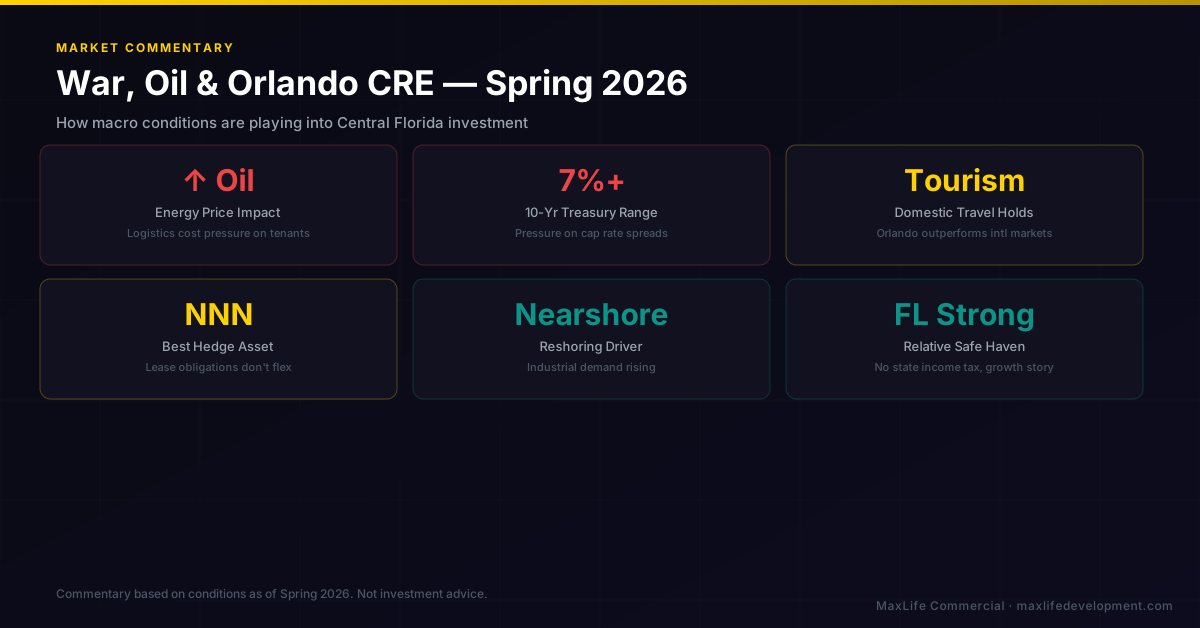
The Setup: Why This Matters Now
Geopolitical conflict and the energy market are tightly linked, and both filter into commercial real estate through a handful of well-understood channels. When war disrupts energy supply or raises the risk premium on crude, oil prices move. When oil prices move, inflation expectations move. When inflation expectations move, interest rates move. And when interest rates move, commercial real estate cap rates, debt availability, construction costs, and tenant demand all respond — not immediately, but reliably.
That transmission mechanism has been unusually active over the past several years. Investors who lived through the 2022–2024 rate cycle already know how quickly a macro shock can reprice an entire asset class. Heading into spring 2026, the question isn't whether geopolitics matters for CRE — it clearly does. The question is which channels to watch, how exposed Orlando specifically is, and what disciplined investors and tenants should do about it.
Channel 1: Construction Costs and Development Timelines
The most immediate CRE impact of higher oil prices is on construction costs. Diesel fuel powers the equipment on every job site. Petrochemicals are embedded in asphalt, roofing materials, insulation, plastics, piping, and coatings. Steel and concrete — the two largest cost categories on most commercial projects — are both energy-intensive to produce and transport. When oil moves up 15 or 20 percent in a short window, hard-cost estimates for projects that haven't locked in contracts start to drift higher within weeks.
For active development projects in Central Florida — and there are a lot of them, particularly along the I-4 corridor, in Lake Nona, and across the growing Lake and Polk County markets — this matters in two ways. First, projects that are still in budgeting or entitlement may see their pro formas pressured. Second, build-to-suit and ground-up projects with lender-set maximum budgets may face tough conversations if material costs creep outside contingency. Developers who locked in GMP contracts in 2025 are better positioned than those still negotiating this spring.
Tenants pursuing a build-to-suit in Orlando should expect contractors and developers to be more conservative on cost exposure, and to push for shorter bid validity periods on major material categories.
Channel 2: Inflation, Interest Rates, and Cap Rates
The second channel runs through monetary policy. Oil is one of the most visible inputs into headline inflation, and sustained price spikes tend to keep central banks cautious on rate cuts. For commercial real estate, the link is direct: cap rates don't move in perfect lockstep with the 10-year Treasury, but they rhyme with it. If rate cut expectations get pushed out, cap rates hold where they are or drift higher, and values soften on the margin.
The flip side, which matters for disciplined buyers, is that cap rate expansion creates entry opportunities. Investors who waited on the sidelines through the last rate cycle are familiar with this dynamic — the best basis is usually available when the macro backdrop feels most uncertain. Orlando deals underwritten with realistic exit assumptions can still pencil at current cap rates, and the off-market pipeline tends to offer better pricing than on-market inventory during periods of macro volatility.
If you're sitting on capital looking for a better entry, our off-market commercial deals pipeline is where we see the best spring 2026 opportunities.
Channel 3: Debt Markets and Refinancing
Debt capital markets react to the same macro signals. Spreads widen when volatility rises, and lenders get tougher on structure — lower proceeds, tighter DSCR covenants, shorter interest-only periods, and more conservative underwriting on exit cap rates. For owners with debt maturing in 2026, a spring energy shock could make refinancing meaningfully more expensive than the base case assumed when the original loan was closed.
Orlando-specific owners should take a hard look at any loan maturing in the next 12 to 18 months. Running a realistic refinance scenario now — at current rates, current spreads, and current proceeds — is much better than discovering the problem 90 days before maturity. Owners with refinance gaps have options: sale-leaseback, joint venture recapitalization, or disposition into a still-active buyer market — but those options all work better when there's runway.
Channel 4: Tourism and Orlando's Hospitality-Retail Complex
This is where Orlando diverges from most other major CRE markets. Orlando's retail, hospitality, and experiential real estate are tied to the roughly 75 million visitors the metro welcomes each year. Higher oil prices raise airline fares, fuel costs for road-trip visitors, and the general cost of travel. In a world where discretionary income is under pressure from sticky inflation, the tourism economy is the first place you'd expect a pullback.
The counterpoint is that Orlando has historically been more resilient than tourism-dependent markets that rely on a single customer segment. The Orlando visitor base is diversified across domestic and international tourists, business conventions, and event travelers. Disney and Universal both have enormous scale and pricing power, and their continued investment in new attractions (Epic Universe chief among them) tends to draw visitors even when the broader economy is soft. Retail and hospitality investors in the I-Drive and US-192 corridors should monitor visitor volumes and RevPAR closely this spring, but shouldn't assume a 2008-style collapse — that playbook has rarely held in Orlando.
For more on the tourism corridor specifically, see our Orlando entertainment district investment guide.
Channel 5: Industrial and Logistics — A Mixed Picture
Industrial and logistics real estate has a more complicated relationship with oil prices. On one hand, higher fuel costs make last-mile distribution more expensive and put pressure on thin-margin logistics operators. On the other hand, supply chain disruption from geopolitical conflict has historically been a tailwind for domestic warehousing, as companies hold more inventory closer to end markets rather than relying on just-in-time imports.
For Central Florida industrial — particularly the I-4 corridor, the Space Coast, and Polk County — the near-term outlook is still constructive. Demand drivers are more structural than cyclical: population growth, e-commerce penetration, and the continued build-out of statewide distribution networks. A spring oil spike may slow new speculative development, but it's unlikely to meaningfully soften rents on existing Class A product. See our page on industrial property for sale in Central Florida for a deeper submarket view.
By the Numbers
The five channels above are qualitative — here's what the same story looks like in charts. The data is illustrative and directional: construction-cost exposure is based on industry-level estimates, the sector sensitivity scores are our own directional view for Orlando, and the cap rate sensitivity chart is pure math on a hypothetical $5M NNN deal. The purpose is to make the mechanism visible, not to predict specific outcomes.
Construction Hard Costs Exposed to Oil-Linked Inputs
Share of a typical commercial construction budget that moves with oil and petrochemical prices. Illustrative industry-level estimates.
Combined oil-linked exposure across these categories can account for roughly half of a commercial project's hard cost budget — which is why even a modest sustained oil spike flows through to development pro formas.
Orlando CRE Sector Sensitivity to an Oil / Geopolitical Shock
Directional sensitivity score (1 = low exposure, 10 = high exposure) based on tenant demand, debt profile, and pricing power. Illustrative.
Necessity retail, medical office, and NNN credit-tenant properties tend to hold pricing power through macro volatility. Hospitality and tourism-linked assets are the most exposed in the Orlando market.
Cap Rate Sensitivity: $300k NOI NNN Property
How a 100 basis point move in cap rates changes the value of a hypothetical Orlando NNN deal priced at $5M / 6.0% cap. Pure math example — value = NOI ÷ cap rate.
A 100bps cap rate expansion — a realistic move in a risk-off environment — wipes roughly $700k off this deal's value. For leveraged owners, the equity impact is amplified. This is why stress-testing exit cap rates matters more than most other underwriting assumptions right now.
How Central Florida Is Positioned
A few factors work in Central Florida's favor in this type of environment. Florida has no state income tax, which insulates household purchasing power relative to high-tax states. Population growth continues to outpace the national average, creating steady demand for housing, retail services, and medical space regardless of the macro cycle. The Space Coast's aerospace and defense economy is actually a beneficiary of elevated geopolitical tension — defense contractors and space launch operators tend to see increased order flow in periods of heightened global risk.
The markets within Central Florida that are most exposed to a spring oil shock are hospitality-dependent submarkets, over-leveraged owners with near-term debt maturities, and speculative developments without locked construction costs. The least exposed are stable NNN investments with national credit tenants, grocery and necessity retail, medical office, and long-term owners who don't need to refinance soon.
What Investors and Tenants Should Do This Spring
For investors: stress-test any active acquisition for a 100-150 basis point move in exit cap rates and a modest increase in debt costs. If the deal still pencils, it's probably a good deal. Look harder at off-market and distressed opportunities — macro volatility separates the prepared from the unprepared, and that creates pricing inefficiency. Prioritize assets with pricing power: necessity retail, strong medical office, NNN with credit tenants, and well-located industrial.
For tenants: if you're considering a build-to-suit project, lock in construction pricing and lease terms now rather than waiting for better conditions that may not materialize. If you're leasing office space in Orlando or retail space for rent, landlords are more flexible right now than they will be in a tightening market — TI packages and free rent are negotiable.
For owners with near-term debt maturities: start the refinance conversation now. If the gap is too large, consider a 1031 exchange into a better-positioned asset rather than force-selling into a soft market.
The Bottom Line
War and oil price volatility are real risks for commercial real estate this spring, but they don't affect every asset class, submarket, or owner the same way. Central Florida is better positioned than most metros to weather a macro shock, and disciplined investors with capital tend to do well in exactly these environments. The key is to underwrite realistically, avoid forced decisions, and pay attention to the channels — construction, debt, tourism, industrial — where the impact actually shows up.
If you want to talk through how current market conditions affect a specific property or strategy, get in touch — we're happy to run the numbers.
Related Articles
Orlando CRE Market Report 2026
Cap rates, sector outlooks, and investment strategies across Central Florida for the 2026 vintage.
Orlando Cap Rates Investor Guide
Current cap rates by property type and how to find value in a shifting market.
How to Evaluate a CRE Deal
Metrics that matter when macro conditions are uncertain — cap rate, NOI, DSCR, and tenant credit.
NNN vs. Multifamily Investing
Which asset class holds up better in a volatile rate environment — a side-by-side comparison.
1031 Exchange vs. Opportunity Zone
Two tax-deferral strategies compared — which one fits your situation and timeline.
Florida CRE Investor Guide
The structural case for Florida commercial real estate — growth drivers, tax advantages, and strategy.
Want to Stress-Test Your Orlando CRE Strategy?
Whether you're buying, selling, refinancing, or leasing, we can help you pressure-test your plan against the current macro backdrop — and find the opportunities that volatility creates.
Get Off-Market CRE Deals in Your Inbox
Join our investor list for exclusive Central Florida opportunities, market reports, and deal analysis — delivered weekly. No spam, unsubscribe anytime.