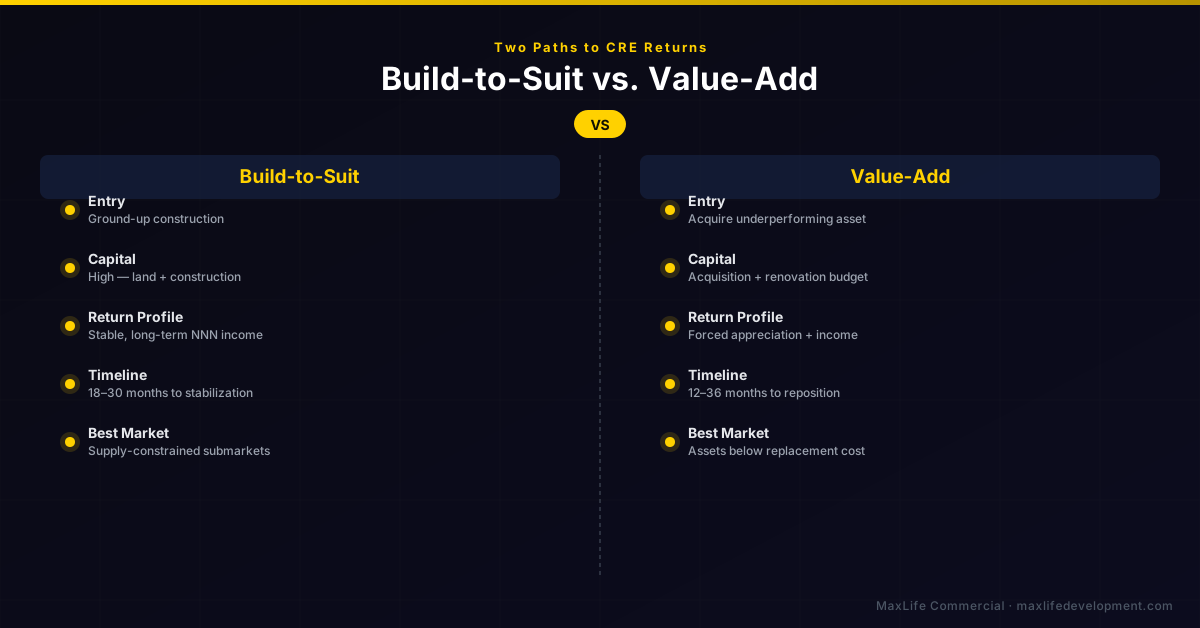
Commercial real estate developers and investors generally fall into two camps: those who build new (build-to-suit) and those who buy and improve existing properties (value-add). Both strategies can generate 20-35% IRRs when executed well. But the capital requirements, timelines, and risk profiles couldn't be more different.
Build-to-Suit: The Development Spread
In a build-to-suit (BTS) deal, you acquire land, secure a tenant commitment (signed LOI or lease), build a property to the tenant's specifications, and sell the completed income-producing asset at a stabilized cap rate. Your profit is the development spread — the difference between all-in project cost and disposition value.
Typical BTS economics in Florida:
- Total development cost: $1.8M – $3M (typical single-tenant NNN)
- Stabilized disposition price: $2.1M – $3.5M (at 5.75–6.5% cap)
- Development spread: 150–250 basis points
- Gross profit margin: 15–25% on total cost
- Timeline: 12–18 months land-to-exit
Value-Add: The Repositioning Spread
Value-add investors buy underperforming commercial properties and increase value through rent growth, expense reduction, physical renovation, tenant improvements, or lease restructuring. Your profit is the repositioning spread — the difference between stabilized value and total investment (purchase price + renovation costs).
Typical value-add economics:
- Purchase at 7.5–9% cap rate (underperforming asset)
- Invest 15–25% of purchase price in improvements
- Lease up / reposition over 12–36 months
- Exit at 5.75–6.5% cap rate on higher NOI
- Target IRR: 15–25% over 3-5 year hold
Side-by-Side Comparison
| Factor | Build-to-Suit | Value-Add |
|---|---|---|
| Capital Required | $300K–$750K equity (75% LTC) | $400K–$2M equity (70% LTV + reno reserve) |
| Time to Exit | 12–18 months | 3–5 years typical |
| Primary Risk | Tenant default before completion, cost overruns | Lease-up failure, market softening |
| Return Profile | Single profit event at exit | Cash flow + appreciation over hold |
| Skill Required | Entitlements, construction mgmt | Market analysis, property mgmt |
| Tax Treatment | Capital gain at sale | Depreciation during hold + gain |
| Liquidity | Low (illiquid until completion) | Medium (can sell anytime) |
| Scalability | Replicable with pipeline | Deal-by-deal |
When Build-to-Suit Wins
BTS outperforms in:
- Growing markets with inadequate retail supply (most of Florida)
- Declining cap rate environments (new product demanded at tight rates)
- Active tenant expansion programs (dollar stores, auto parts, QSR, pharmacies)
- Investors who want clean exits and repeatable pipelines
When Value-Add Wins
Value-add outperforms in:
- Markets with distressed / underperforming inventory
- Rising rent environments where lease restructuring captures upside
- Investors who want cash flow during the hold
- Tax-sensitive investors who benefit from depreciation
- Markets where land is expensive but existing assets are cheap
The Florida Reality Check
Florida's population growth and underserved secondary markets heavily favor build-to-suit right now. With 300,000+ net new residents annually, tenant expansion programs in growth corridors, and tight retail supply, BTS developers are capturing strong development spreads on dollar stores, QSR, auto parts, and pharmacies.
Value-add opportunities do exist — particularly in older Orlando retail centers, secondary market office, and underperforming multifamily — but competition is fierce and pricing often leaves little room for error.
Our Take
For most investors in 2026, build-to-suit offers better risk-adjusted returns in Florida thanks to the population tailwind and active tenant pipeline. But the best-performing CRE portfolios use both: BTS for capital velocity (12-18 month turns), value-add for compounding cash flow. If you want to understand which makes sense for your capital, let's talk.
Related Articles
Build-to-Suit vs Existing Commercial
BTS vs leasing or buying existing space — timeline, cost, and customization tradeoffs.
Why Central Florida Is Hot for Land Development
Population growth and corridor-by-corridor land demand driving BTS opportunity.
What Is a Triple Net (NNN) Lease?
BTS delivers NNN leases as the exit — understand the end product before you build it.
How to Evaluate a CRE Deal
Underwriting a value-add acquisition requires the same IRR/DSCR framework as any deal.
Orlando Industrial Real Estate Guide
Industrial is a key BTS and value-add sector — current market conditions in Central Florida.
Florida CRE Investor Guide
Why Florida — population tailwinds that support both BTS and value-add strategies.